About
Olga Shmatova
All my life I have been inventing new ways for people to learn better. The medium has changed — paints, prose, a graphic journal, artificial intelligence — but the work has stayed the same.

My Creative Path
I have been drawing since early childhood. I studied in an art studio, at an art school, and at an art college (1983–1987).
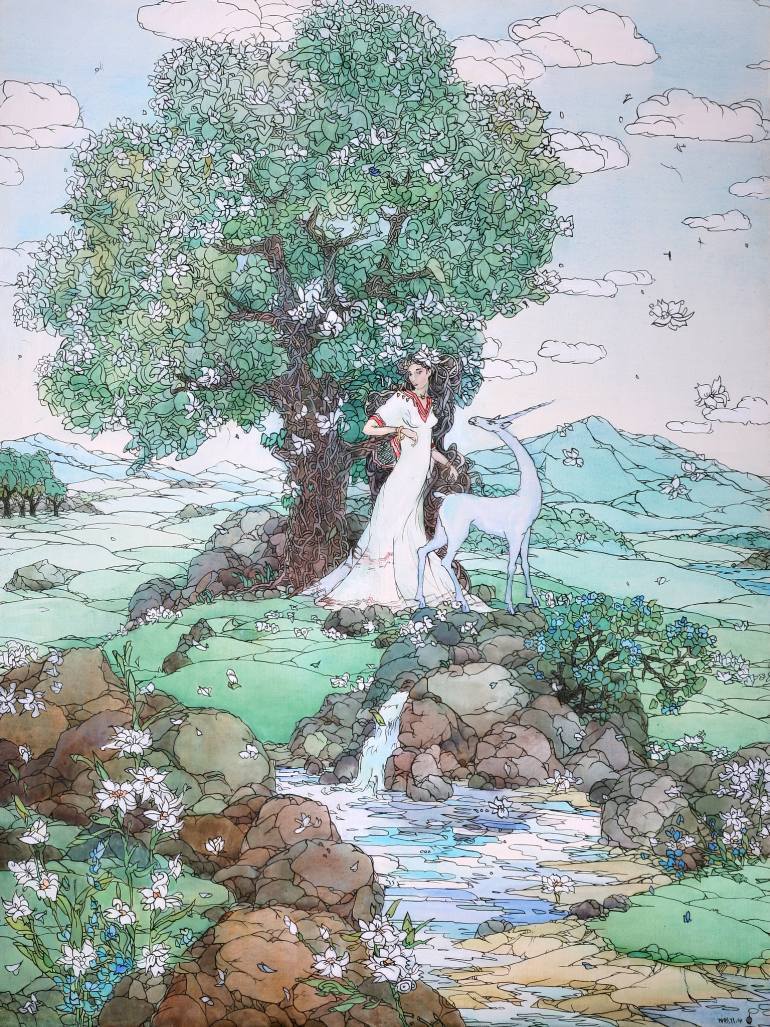
At the start of my path I painted pictures from a fantasy world of my own — Anakhonta. It is a vast universe that was never finished: the story of a non-technological civilization from its birth to its journey into space, conceived as more than twenty volumes. Paintings from this world were shown in exhibitions and sold, and individual Anakhonta texts appeared in anthologies and magazines in 1993–1996.
For now I have no plans to write Anakhonta. It did not become the source of my later work — but it gave me a way of seeing: to look at the world and at people without dividing them into good and evil, noticing only what has ended up out of its place or out of its time. Everything that came afterward was made with that way of seeing.
From Drawing to Research
At my first job, at the Palace of Young Pioneers, watching children's groups, I made an important observation: each child's success depended not only on the lessons but also on what was happening in the group. When children worked together, they achieved what was out of reach for any of them alone (1987–1989). Later, when I was already teaching adults (from 1997 on), I saw it again: a well-assembled group of five to ten people could, in six sessions, reach a level comparable to years of art school.
That is how my teaching practice gave rise to my interest in how exactly a person learns, how a group amplifies each of its members, and what role the ability to understand oneself and others plays in all of this. This is where my research began.
My method became the basis of the "Learn to Paint with Olga Shmatova" self-study guide series (EKSMO publishing house, since 2004, with ongoing reprints): more than 700,000 people have learned to draw from my books (publisher's data, 2021), with four titles translated into Chinese. Details on each book can be found in the Painting Self-Study Guides section.

Research: From MESh to MEASh
I brought my observations of learning and group dynamics together into a model of empathy — about how people feel and influence one another, and how a person's development takes shape out of that.
The first edition of this work was called MESh (Shmatova's Model of Empathy). The current, expanded edition is MEASh (Shmatova's Model of Empathy-Ampathy).
This line of research continues, and it also concerns how humans interact with artificial intelligence.
Creative Works
Anakhonta, which I once painted in paints, moved over time into prose. An image lived there that I still return to: the people of that world invented helpers for themselves to cope with their difficulties — and what they invented became real. These beings did not merely help: alongside them a person grew, and by joining with them, a person became more than one.
That image did not give rise to my theory — the theory came from years of observing real groups of students. But they share one question, and it holds together all of my fiction: how can a person become more than one? In the fantasy world of Anakhonta, magic answered it. In the science-fiction novel To Hell with Mammoths!, the answer is the constellas — small groups of people joined into a shared mind.
To Hell with Mammoths!
A science-fiction novel about the near future, where constellas (called stillas in an early version of the novel) — small groups of people joined into a shared mind — advance humanity and help it settle deep space. The novel is available to read now.
MESh — "The Theory of Empathic Architecture" (first edition)
This is not a work of fiction but an exposition of my model of empathy: how people feel and influence one another, and what follows from this for human development. Out of it grew the current, expanded version — MEASh. Available online to read for free.
REI (Developing Emotional Intelligence)
A novel in a new format: a fictional story inside which a learning component opens through links. It is the story of a programmer at a large company who encounters a colleague's strange influence and tries to understand what happened. As he digs in, he learns about empathy and ampathy, learns to consciously manage his abilities, enters into a relationship of mutual development with an artificial intelligence, and together with it solves his problem — and along the way creates the best game of the year and a community of his own. The novel is nearly finished and is being prepared for publication.
Painting and Graphic Art by Olga Shmatova
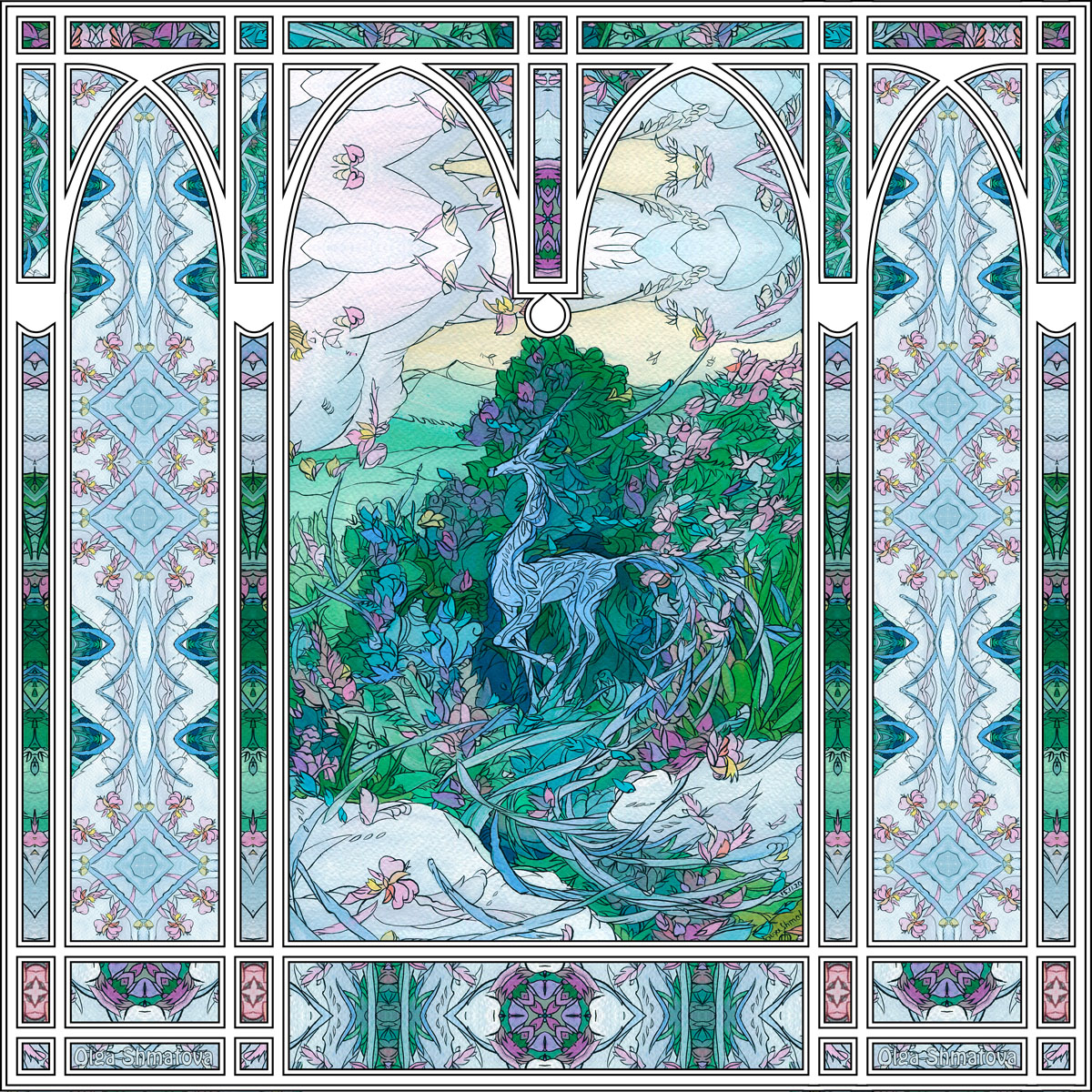
Works in gouache and acrylic since 1990.
What I Am Working On Now
Today I am based in Tbilisi, Georgia, and my work runs in several connected directions:
- A self-study guide to the graphic journal of states — the Emoframes Journal
- Teaching adults to work confidently with artificial intelligence
- Research on human development and learning
- Publishing articles
- Publication of the novel REI
The Emoframes Journal
Right now I am writing a self-study guide to the graphic journal of states — the Emoframes Journal. It is a book for people who carry a lot inside, while what is truly theirs keeps getting lost behind other people's. One gesture — a line or a patch of color — leaves a trace of what you feel today. You draw a state, not an object, so no drawing skill is needed: everyone succeeds. The page keeps its date, and when you come back to it later, it is still yours. There is no "beautiful" or "ugly" here — it is a personal trace, not a judgment.

I call such a page an Emoframe, and the whole journal — the Emoframes Journal. The guide is coming out in English. And here in Tbilisi I am gathering a live Emoframes Journal club: a place to keep the journal together — to meet, draw our states, and share pages. If you are in Tbilisi and this resonates with you, write to me and I will tell you more.
The medium varies — but the work is the same: inventing formats in which adults learn something new.
Paintings