
About Olga Shmatova
For 20+ years I’ve been asking one question: how do adults master complex skills from scratch — and why do some methods work while others quietly fail?
The answer didn’t come from theory. It came from teaching.
Origin
I started with adult beginners in drawing and painting — people mostly convinced they had no talent. Working with them in studio settings in Moscow (2003–2011), I developed a method with two defining features: I teach people to think like an artist rather than copy technical procedures, and I cut classical art theory back to what’s actually needed for independent work.
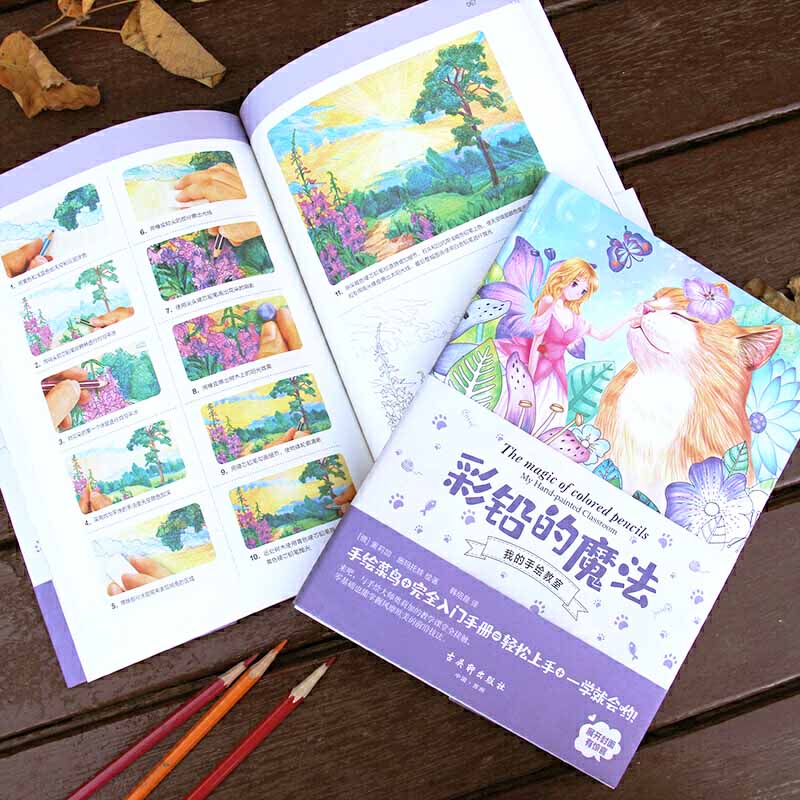
The method produced two kinds of evidence that it works. In the studio, adult beginners with no prior experience were reaching independent creative work within a modest number of sessions. In print, the method — adapted for self-study — scaled to 6 instruction books published by EKSMO, 700,000+ copies sold, with translations into Chinese and new editions still coming out.
Different formats, different kinds of evidence — both pointing to the same underlying principles.
Along the way, I kept noticing things existing pedagogy couldn’t explain. Skills were forming in ways textbooks didn’t predict. Knowledge was transferring between people through channels nobody was explicitly teaching. Over the following years, I built the theoretical framework that accounts for what I’d been observing.
Background
I started with adult beginners in drawing and painting — people mostly convinced they had no talent. Working with them in studio settings in Moscow (2003–2011), I developed a method with two defining features: I teach people to think like an artist rather than copy technical procedures, and I cut classical art theory back to what’s actually needed for independent work.
The method produced two kinds of evidence that it works. In the studio, adult beginners with no prior experience were reaching independent creative work within a modest number of sessions. In print, the method — adapted for self-study — scaled to 6 instruction books published by EKSMO, 700,000+ copies sold, with translations into Chinese and new editions still coming out.
Different formats, different kinds of evidence — both pointing to the same underlying principles.
Along the way, I kept noticing things existing pedagogy couldn’t explain. Skills were forming in ways textbooks didn’t predict. Knowledge was transferring between people through channels nobody was explicitly teaching. Over the following years, I built the theoretical framework that accounts for what I’d been observing.
Current work
Today my work runs on three connected tracks.
Research. I’m developing two theoretical frameworks. Creative Dynamics (CD) is a structural model of how skills form, automate, and combine into more complex ones. It treats any complex skill as a tree of atomic sub-skills at measurable automation stages — which makes learning time computable from the gap between what a person already knows and what they need to learn, not from the complexity of the target skill itself. MEASH is a model of how knowledge and skills transfer between people through empathetic interaction. Originally developed to explain accelerated learning in groups, it turned out to apply to human-AI interaction as well — an unexpected bridge I’m now actively exploring.
Products. The first deployed application of these frameworks is Genie in Your Pocket (geniepocket.ai) — an AI-literacy course running on the Claude API. It teaches non-technical adults to work with AI not by memorizing prompt templates, but by building a working mental model of their AI counterpart.
Public writing. I am publishing a Substack series called Between Minds — essays on long-term human–AI partnerships, the pedagogy of complex skills, and what happens between minds when both develop. The research program behind my products carries more than any single product can hold, and essays are the right format for ideas that don’t fit into code.
The first essay introduces sovangard — a framework for symmetrical development in human–AI relations, distilled from twenty months of practice. Read on Substack →
Background
In education since 1987. Trained at Saratov Art School (Painting & Pedagogy Department, 1983–1987).
Founded and ran an art studio for adult beginners in Moscow (2003–2011).
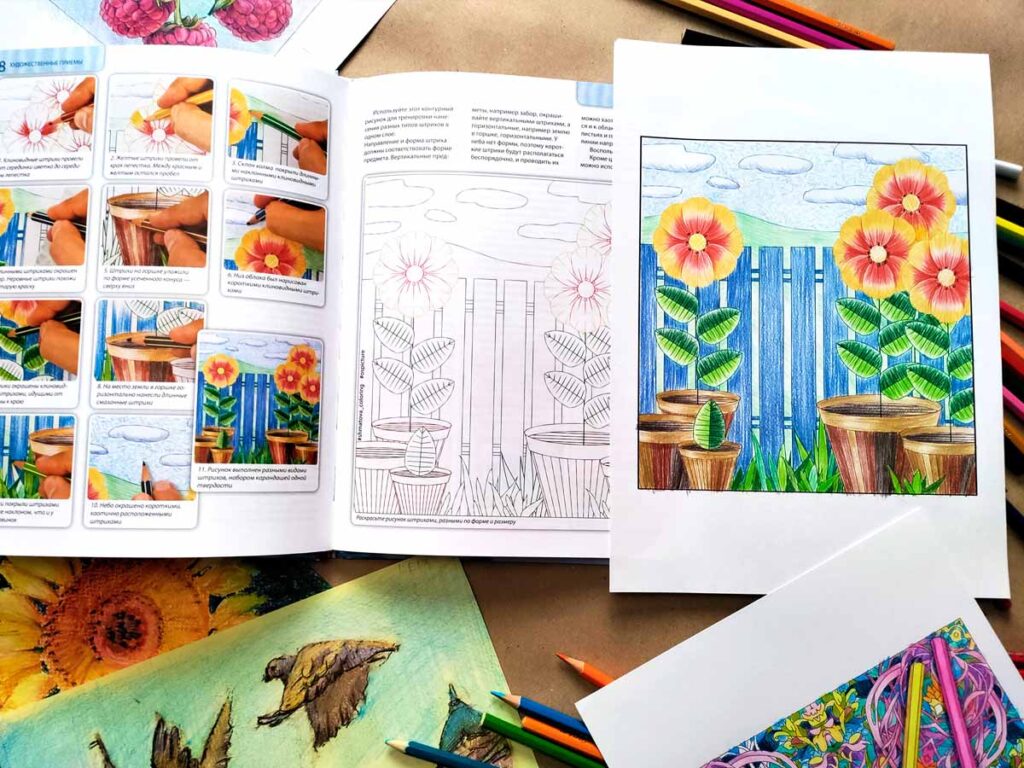
Author of 6 instruction books published by EKSMO; 700,000+ copies sold; four titles translated into Chinese (2019–2020); new editions continue to appear, including a 2021 title on drawing with markers, liners, and felt-tip pens.
Now based in Tbilisi, Georgia.